Written 3447 C.E
A Traveler's Guide To The Sun Empire
May the sun grace you dear reader. You are now holding a glorious book that will give you a surface look into the exalted empire belonging to the sun kissed, tall magnificent Ashanti who inhabit the easternmost land of Argalos.
Ashant or also known as the Sun Empire or the Dawn Kingdom is the largest country on Argalos behind it follows Barahaus. It is unknown how and when this land was settled but according to Ashanti legend they believe that their people were sent by the glorious sun to bring light and civilization to the dark, tribal lands of Argalos. Although legend, it is considered true that the Ashanti have emigrated from a forgotten land due to their distinctly unique culture, appearance and historical records speaking about some kind of an invasion three millennia ago. The original settlers were all but eliminated or assimilated into the invading people since there are no traces of them today. Their tribal rituals, feeble primitive spells and clubs could do nothing to Ashanti bronze scimitars and military organisation.

"Depiction of the Ashanti invasion"
There are still ruins of the original denizens of Ashant but their secrets have been long lost to war and conquest. But since that fateful day three thousand years ago, the proud warmongering Ashanti have only expanded and solidified their place on Argalos as a continental superpower.
The earliest recorded Ashanti wars were that of the Expansion wars (0-24). The expansion wars marked the beginning of the common era which is the calendar used today continentally. Ashant or as it was called at the time Ukulwa expanded from the coastal jungles and swamps to the south of Dragonstar to the barren danger filled deserts of Rubaida. The original settlers were displaced and the first country ever was established under the rule of Jabal the Dawn King. There is a 300 foot statue of him built in Rubaida which has stood tall for over 3400 years.
Ukulwa conquest continued and during the span of 110 years they expanded from the jungles to the south, to the once temperate forests of Solis. But during the Ukulwa conquests
(32 to 144) they faced their toughest challenge yet. The unification of the Nedes, the ancient people who inhabited present day Varanheim, parts of Barahaus and Chausan. They were all united under a former Nedic slave who managed to get formal education in Ukulwa lands. He escaped and brought Ukulwa ways of military organisation to the tribal people of the Skarack region. They united under him and he became known as Haraldr the Chainless. The sheer number of Nedes overwhelmed the proud and isolationist Ukulwans and they lost the war of freedom (189-210).

"Haraldr the Chainless (160-223)"
After this, technology rapidly progressed in other parts of Argalos and the Ukulwans lost their superiority. It was now when the other cultures blossomed and Ukulwans stagnated. For 500 years the world progressed rapidly, iron was discovered, years later bows were invented.
During these years the Ukulwans were subjected to multiple civil wars and the country was in turmoil. The Ukulwan dynasty was toppled and many dynasties tried to take over but no one could rule for more than a decade. But then in the year 1120 a strong new dynasty took over. That of the Hargeis family, they managed to put Ukulwa now called Hargeisi on the map again.
For they had discovered something that gave them an edge in war, the Hargeis dynasty had managed to refine and improve the simple arcane rituals the original settlers and Nedes had known. They turned magic into a weapon and many enemies fell at their feet. Lands were swiftly conquered again and Hargeisi was a superpower once more.
This was the time of the First Hargeisi Empire which was even further expanded by a legendary man called Ashant the Exalted (1312-1446)
In merely 50 years he managed to create a vast empire which stretched from the coasts of eastern Ashant to the riverlands of western Barahaus. His empire was so great that it’s size has never been rivaled ever again. Ashant the Exalted is the most revered of men in Argalos history; his genius was beyond mortal conception. He lived for a staggering 134 years and it is said that he could only die whilst sleeping for if death had come when he was awake it would have been the one going to the grave.
He also wielded a longsword said to have been forged of meteoric steel, smelted in the flames of the Garaldabur volcano in Nicea and tempered with the oils from dragon scales. Of course this is just a myth most likely fabricated to explain his immense battlefield duelist success.

"Ashant the Exalted drawn by 20th century Barahausian"
Although when Ashant died the empire had a tough time to remain stable due to conquered lands rebelling and after 200 years the Empire collapsed in 1649 leaving only the original province of Ashant left.
After this the lands of Argalos were finally stable for many years, all countries too exhausted to cause war, but then tragedy struck. In 1932 an invading force consisting of a legion of 200,000 men from beyond the Wrathful Sea came and laid absolute waste to Argalos. They managed to swiftly instate a new government in Ashant and they continually harassed the entire continent with only Barahaus managing to resist their assault. The whole continent except Barahaus bent their knee to the invading force.
This time in history has been called “The Red Horde invasion” since it was said that these people had reddish skin, short and folded eyes, with curved blades and intertwined armor. They ruled the continent through tyranny for 400 years allowing for people of the red horde to proliferate. Installed on the throne was the Temuj dynasty. The Temuj bloodline built and sat upon the Sun throne in Ashant and ruled the continent for 4 centuries until an unknown assassin murdered their entire bloodline leaving behind a power vacuum amongst the red horde except for the province called Öndörkhan which remains to this day a memory of the Red Horde's presence. This instability enabled the continent to free themselves from their oppressors. The continent was devastated, all but Barahaus.

"Red Horde Riders"
Thus Barahausians took this opportunity to usher in the Lion's Age. A time of heavy Barahaus influence, chivalry, noblery, bravery and swordsmanship. Which began in 2347 and ended in 2982.
This was a time of darkness for Ashant which was now called Temuj due to the Red Horde influence still being prevalent. For the country of Temuj the lion's age was a time of cutthroats, warmongering and aspiring warlords. At its height the province of Temuj was divided into 22 states. Temuj was incredibly unstable and the crown was up for grabs for anyone who could conquer these savage lands. A barahausian managed to conquer Temuj and sat upon the throne for 11 years. This was a wakeup call for the Ashanti people and they united under Farooq “Sword of the Sun” Qadim who put the country in order and back on its feet. The Lions age ended when Farooq killed the king of Barahaus on a supposed “diplomatic mission to Temuj”. This goaded Barahaus into a conflict that resulted in a pyrrhic victory for Farooq´s faction at the naval battle of Qyrian Bay.

"Battle of Qyrian Bay, a pyrrhic victory for Farooq Qadim"
After Farooq died in 3002 his son Dard Qadim changed the name Temuj to Ashant again in honor of Ashant the Exalted. The empire was now back on its feet. The Qadim dynasty has ruled since Farooq´s death. During the 410 years leading up to the writing of the book there were three notable wars. The Sacking of Chausán (3270-3278) when all nations attacked Chausán in hopes of taking control of a material called red steel which was found in Chausán mountains.
*Red Steel is extremely durable and is said to be able to split a rock by dropping a sword on it*
The war ended with no conclusive winner and only served as a catalyst for the next war. War of Ashant (3343-3345) when Turin supplied Chausánite warbands attacked Ashant and destroyed mines and trade routes in order to weaken Ashant for an invasion. The invasion was successful and many Ashanti denizens were displaced and trade was halted for many years.
This fueled the Ashanti-Chausán hatred even more and was one of the background reasons for the Five Banner War of (3389-3394). Since the war ended mostly in a draw it is sure to spark another war anytime soon and the next war will surely be worse than the previous one.
Ashant Today
Ashant today is divided into 5 districts that each have a clan family governing it. The districts are Harga, Solis, Sentinel, Gao, Dragonstar and Goldthrone. They are each governed by the descendants of great clan fathers.
Sons of Takrur, Sons of Ngola, Sons of Warabe, Sons of Thyjara, Sons of Hakam and the Sons of Qadim.
The position of clan leader is not inherited by the firstborn; it is earned through prestige. All clans have open succession laws. But they are all patriarchal in nature.
Each district acts as its own autonomous state. But they all answer to the Qadim clan. Here is a summary of interesting locations and what makes each district unique.
Harga
The district of Harga is generally defined as from Nairob to Darod to just shy of Ablis and everything in between even down to the coast. Harga was a very overlooked district before the five banner war but it has since become an economic powerhouse because of the newly conquered lands of Chausán being attributed to the Takrur Family. In western Harga you have the great Ardun forest and to the east you have the Red Desert.
The district of Harga as previously mentioned was the poorest and smallest of all the districts but the addition of the Ardun forest has enabled Harga to cultivate even more exotic fruits such as Tang-mo, Rubb and Dragonbells. Harga is the main supplier of food for the entirety of Ashant due to its vast agriculture. Harga feeds the country and without it many would die.
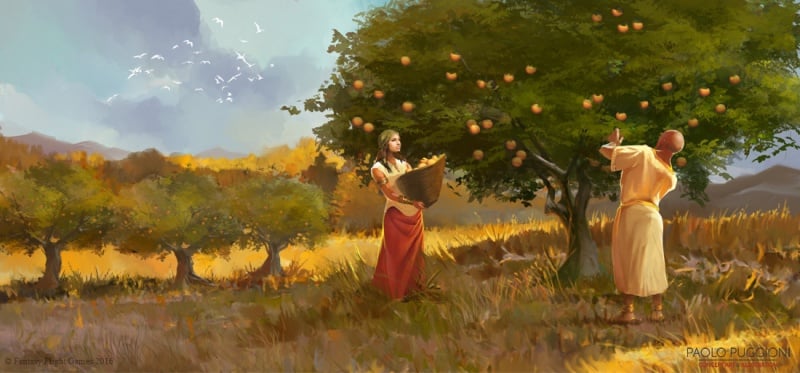
"Rubb Gatherers outside Harga"
Unfortunately due to its agriculture potential it is home to many unlawful crops such as leopard orkid. There are many crime rings in Harga and the need for workers has increased the prevalence of bandits. The two most profitable offences in Harga are human enslavement and the cultivation of illicit plants. Since this is highly profitable the Takrur family has done little to stop it and many wealthy families stand to gain from it.
Some geographic places worth mentioning in Harga are:
The Ardun Forest, a dense, great and elden place initially home to Chausán Druids but then conquered by the Ashanti. They say that the druids cursed the forest when it fell into our hands but nothing has happened yet.
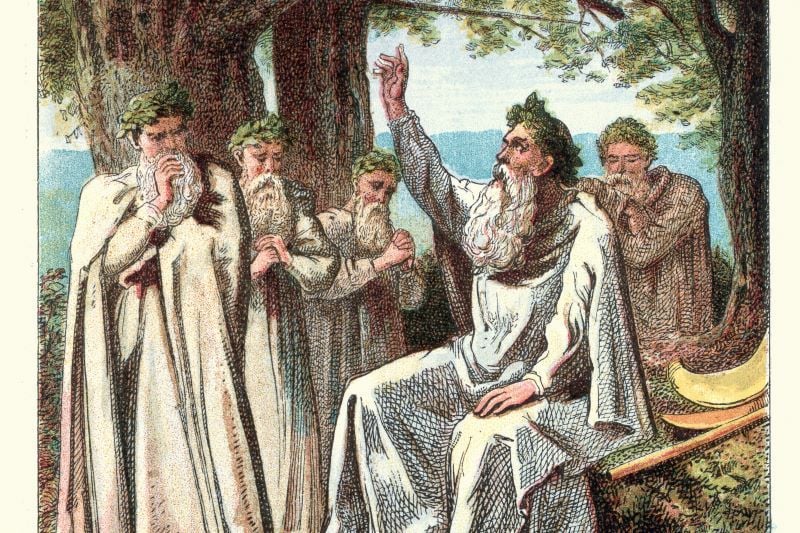
"Chausanite Druids"
The Red Desert, one of the 3 deserts in Ashant.
It stretches from the east of the Rumare river outside of Harga to just outside of Goldthrone. It’s southern point is in Elemit and the desert ends in Redvil. The desert itself is red and home to many cliffs and rocks. It is also the hottest desert in Ashant, fortunately sandstorms rarely occur. The desert is home to ancient nomads who amazingly manage to sustain themselves in the desert. Many people unfortunately die in this boundless ocean of sand due to its unbearable heat.

Other places of note are:
The city of Harga which is quite old being almost 500 years old. It was founded by Farooq as a military naval outpost to guard the river and produce ships. Harga was an important manufacturer of ships for many centuries until the War of Ashant when Harga was sacked, looted and destroyed. After the war Harga did not receive much aid from the Talif (King) and it became a decrepit township. The clan that ruled Harga before called Furqa were left weakened and impoverished. They were subsequently overthrown by the Takrur Clan.
They abandoned the ship building trade and instead focused on agriculture, still Harga was poor but now with agriculture it was less so. After the war the Takrur family gained control over the Ardun Forest and other Chausán lands, this filled their coffers with gold now that they could produce large amounts of exotic foods.
The city of Harga is a marvel, it uses complex waterways to produce fruits as effectively as possible. The city is filled with canals and there is always an abundance of food here, every other person in the city is a culinary master and festivals are frequent. Music is almost always heard and the city is filled with beautiful gardens and fruits are more common than people.
There are even pleasure boats to be rented if one would like to sail upon one of the many canals of Harga. Life there is carefree if you are…. Free. If you are a thrall it is much harder. Long hours of work in a hot climate where shade is rare. But if you are in Harga it would be wise to pretend the thralls don’t exist. So that you can enjoy the fruits of their labour in peace.
Solis
The district of Solis is ruled by the Ngola family. It is the least populous district in Ashant and it has few cities. It is often called the place where civilization cannot reach. The people of Solis are obsessed with the old ways and as a result there aren’t many settlements. The majority of Solis is home to tribal people who won’t endorse the new ways. They value strength and physical prowess above all and the Talif (King) has had great trouble in getting them to respect his rule.
The people of Solis have various different customs but they are all to some degree horse cultures.
Solis consists of great broad steppes, lofty mountains and cold deserts. This tough landscape has created equally tough people, there is little room for the weak in solis. The people of Solis are truly peculiar; they live in polyamouros family bands called circles in which several men and women share partners. For most Ashanti’s this practice is outrageous. The people of Solis also reject the triumvirate and instead have another way of life called Ja’shiir. Only females can be clerics in most Solian cultures.

"Solian Steppes"
The only reason the Talif allows the people of Solis to persist is because they are excellent cavalry men and supreme warriors.
Some geographic places worth mentioning are:
Naba’s Back, which is the second desert in Ashant, it is a so called cold desert meaning that it has searing summers and frigid winters. It is here that solians become men, they must spend a year surviving in this desert, a feat which is quite hard to accomplish. The desert is named after Naba, one of the three sister stars. It is said that when the Ashanti left the old ways the very earth itself cried until it could no longer weep, until it was dry. Naba’s back is located to the east of the city of Sentinel.
The Tail Mountain range, it is the biggest and only mountain range in Ashant, it is here where most of the ores are mined in Ashant, it is filled to the brim with gold and iron. It has been mined for many years but it seems that the tail is hiding many secrets because for every cavern mined, miners report ruins.
Nevertheless the tail has proven very vital in the building of Ashant. It is also home to many tribes who manage to live in the mountains. Though it is truly treacherous with glaciers giving way and snowstorms leading you astray. There are still century old bodies in the mountains waiting for you to join them.
The difficulty in which it is to traverse the mountains has led to the tail being one of the least chartered areas of Ashant and maybe even Argalos. What mysteries lie there is only for the brave to find out.

Some places of note are:
Dairs Tower which is an ancient structure built long ago, there are 7 doors which lead into the entrance but despite many kings best effort only one door has opened. The doors are constructed out of an unknown material and they are all as tall as 20 men. The tower itself is not actually a tower but instead it seems to be built into a mountain and so should be called a dungeon. Not much is known about this structure other than that a Barahausian king discovered it and tried to open it. Upon the walls of the first door it says.
“When the first kalpa arrives and the sun does not rise for a day we shall open”
On the second door it says.
“When the lost one finds his calling and an empire burns we shall open”
So it seems that some conditions must be met before the doors open.

Another interesting location in Solis is the ruins of Ashrat Astrella, an ancient temple which the original inhabitants of Ashant built, it lies on the plains for everyone to see, it is a revered site for everyone who follows the Ja’shiir and trips are made there often. According to Solian legend, several of the most devout clerics of Ja’shiir ascended to the sky and became stars. In the middle of the temple there is a tomb and in it there is a piece of the sun buried they say. To steal it would bring eternal darkness according to the Solians.
Now we have the city of Solis.
The city of Solis is home to roughly 100,000 people and it is ruled by the Ngola clan. It is a non-walled city although sparsely populated. It is home to a famous arena called “the iron crucible” where warriors from all over Ashant come to compete in that bloody pit. The city of Solis is known for its competitiveness whether it be running, wrestling or strength competitions; it is here where physical feats are immortalised.
The city of Solis is quite old, one of the oldest cities in Ashant, it has many ancient monuments, tributes to the sun and stars, remnants of the old ways which the ancestors of today's inhabitants used to follow.
Solis has always remained steadfast; it used to be the capital of Temuj. Solis is exceptionally hard to besiege due to it being a logistical problem to sustain a siege for long because of the nature of Solis climate. Solis also has the greatest temple in Ashant and what goes on there is not known to the public but the temple itself is of great architecture and it is truly a sight to behold.
Sentinel
The district of Sentinel is ruled by the Warabe clan; it is the largest district in Ashant stretching from the northern town of Delmir down to Tarsal and Drykeep. The province of Sentinel is quite distinctive, the architecture in most towns is a mix between classic Ashanti design and Varanheimish. What that means is the buildings often have the broad open space and dome like appearance (Ashanti) whilst being structurally sturdy and properly insulated against the colder weather (Varanheimish). Many Varanheimans live in the province of Sentinel and they have brought with them extensive knowledge of armor and weapon crafting. The district of Sentinel is extremely hard working and many aspiring craftsmen relocate in order to learn from the very best. Anything that has to do with building or crafting can be found in this district. Cities in this district are often grand and imposing.
Which ironically fits the weather, the most predominant biome in Sentinel is boreal forest which makes it hard to farm and if you venture further north it becomes a tundra. The weather is frigid and warmth is of the essence. Sentinel is the manufacturer of Ashant and it is here where most armor and weaponry is produced. Iron mined in Solis and shaped in Sentinel. The weaponry and armor designs of sentinel are remarkable.
The people of Sentinel are very intertwined with Varanheimans and therefore it is not uncommon to see Ashanti-Varanheimian couples, the clan of Warabe is no exception. This cultural mix up has created disunity with the rest of Ashant it has also spawned many different political factions in the district each vying for control now that the Warabe clan is losing its identity. But nonetheless the district of Sentinel is truly home to intricate and strange hybrid cultures.

Geographical locations of interest:
Lake Rumare, the largest lake in Argalos, its beauty is unrivaled. The lake is renowned for its restorative properties, alchemists frequently travel to lake rumare in order to collect its water. The water is also very rich in minerals and certain plants grow at lake rumare which are not found anywhere else. It is also home to Ashrays, a rare type of amphibian which are a delicacy but perilous to catch due to their venom.
Lake Rumare is said to have been the Amara’s gift to the Ashanti so that they may have a way to quench their thirst after all their conquest. In Chausanite folklore the lake is said to have been home to Na’arin a great winged beast that ruled the Nedes before recorded history. The beast was beaten and banished by “Daliana” (Naba) to the depths of the lake, where it will drink and die, drink and die until Rumare finally is devoured. Varanheim mythology also has a similar tale.
Another geographical location of interest is the Rimheim Glacier which is the largest ice formation in Ashant, the trip to the Glacier is almost impossible to make due to the cold weather even in the summers. It is here where you can find what little red steel exists in Ashant but excavating it is a dangerous affair since the bitter cold will unite your body with the ice.
The Alkbul cave system in Sentinel is one of gargantuan proportions. It’s caverns twist and turn in endless spirals and no one has truly been able to record it’s size. What is known is that the cave system connects Varanheim and Ashant but a safe and secure route has yet to be established. If such a thing would occur it would line the pockets of whoever discovered it with gold for the rest of his bloodline due to trade being conducted through the tunnel instead of merchants having to travel through fierce tundra.
Sentinel also has the honor of having the great mausoleum called "The hall of Emperors". It is a vast monument dedicated to the burial of important figures, especially leaders of the empire. The crypt of Jabal the Dawn King, Ashant the Exalted and Farooq Qadim are among those that are buried there. The hall of Emperors are guarded first by the great wilderness and then by the finest warriors in the land. Little is known about what goes on there since only the Talif and other with permission may see, but none have ever stolen from the crypt.
Now comes the Jewel of the North, the great city itself Sentinel. Sentinel has combined the very best of Ashanti-Varanheiman architecture, the city features three walls in succession that protect it from any invader, this makes siege towers useless since they would have to mount 3 walls in order to actually get to the city. Sentinel is built around a great hill which sits on the city's eastern side. This makes a siege hard since the city can't be surrounded. There are immense towers overlooking the city's surroundings and the main building called the bastion of horns can shelter many citizens. All in all Sentinel has never fallen into enemy hands during its 400 year old history.
Sentinel started out as a military garrison to oversee and control lake Rumare since it has been heavily contested during several wars with Chausan.
The city itself is an ode to the art of creation, beautiful statues adorn the city, artisans are found in every corner and smiths are a dime a dozen.
Gao
The district of Gao is a maritime area, full of ships, commerce and foreigners. It is the absolute hub of trade in Ashant and as such it is the financial heart of the country. There is much coin to be had in the district of Gao if you have an opportunistic mind. From bustling ports, to foreign spices, clothes, goods to overflowing streets, a person can never be bored in Gao. But beware of shifty merchants, especially those Turin types. On the ports of Gao you can find people from every corner of Argalos, sailors and merchants flock to Gao to try their hand in the numerous trading opportunities that can be found.
The district of Gao itself is ruled by the Thyjara clan, Gao’s power stretches from Elemit to Sandstone and of course Gao itself. The biome of Gao consists mostly of cliffs, rocky beaches, and long coast. Which makes the district quite arduous to traverse. Gao itself sits upon plains but not actually terribly close to the sea. About 25km away. To counteract this problem the Thyjara family built a 25km canal some 200 years ago to enable boats to sail in and out of Gao. This was a huge endeavour and led to many advances in architecture for example the great tower of Gao, a 400 feet tall lighthouse that guides all ships coming in and out. It is said that the Thyjara family has used a special fire that still hasn't died out since its first kindling two centuries ago.
The 25km stretch has since been built upon and the city now stretches to the sea although that area is still sparsely populated and still expanding.

"Trade lies at the heart of Gao"
Geographical locations of interest:
The black sands of Elemit, is a beach on the coast of the city. It is renowned for its alchemical properties and many aspiring alchemists travel to Elemit. It is unknown what can cause the otherwise yellow sand to become dark in this particular place. The black beaches attract more than alchemists, it is here you can find the revered Krakes. A type of fish twice the size of an elephant. Their skin has a green tint and they have 12 fins opposed to a sharks 8. A krake is also quite heavy and they have the temperament of a tiger. They usually spend most of their lives at sea but once a year they return to the coast to mate and it seems that a majority of them choose Elemit. Therefore yearly hunts are organized in order to harvest Krake for their alchemical and commercial properties such as their fins, oils or even meat.
Another location of note are the cliffs of Kayan Bay, the bay between Elemit and Gao. These red cliffs harbor caverns and tricky formations that are exceptionally hard to traverse, most traders usually choose to travel from Elemit to Gao by sea or even travel to Gao through Goldthrone.
The cliffs of Kayan Bay are home to unique flora and fauna, the trees are mushroom shaped, flowers somehow grow through the rocks and there are distinct animals found here that are only found in eastern Ashant. Such as the “Ho-gramin” by local tongue or Legged-Crocodile by common tongue. It is exactly as it sounds: a crocodile with longer legs adapted to land. It is an extremely dangerous predator, it can easily rival a tiger in ferocity and power. They mostly prey upon cliff dogs, capricorns and other lizards that roam the area.
The final geographical location of note is:
Jars Valley which is located to the east of Sandstone. The valley is between two great stone hills and in it you can find ruins from the original settlers of Ashant, old statues, mausoleums and temples are the most common things you’ll find in the valley. This location is a great place to visit if you are a dungeon delver or a scholar of the past. The Jars Valley used to have a river running through it but it has since dried out leaving only skeletal remains of buildings and people left.
As for the city of Gao, it is of immense proportions. Roughly 600,000 people call Gao their home and rightfully so. Gao also happens to be the city of my summer residence, and the city which harbors the majority of the Ashanti naval power. Gao is a city of endless commerce, there is always something new to see. The city is divided in several districts, the lower districts which include the residences at the coast, then you have the main city which is filled to the brim with rich streets, mazes of buildings and scores of merryfolk. Gao also has many elite warrior companies and many mercenary companies for hire. Any aspiring swordsman could join up with these and fight in skirmishes for the lords of Barahaus or the Khans of Öndörkhan. Gao is also called the free city, since slavery is banned within its walls.
Gao is also quite an ancient city, the only older city is Dragonstar which has been a bastion of Ashant since Ukulwa times. Gao is also an intellectual capital having the finest observatories and education in all of Ashant. Anyone wishing to engage in the noble pursuit of knowledge must visit Gao.
Dragonstar
The district of Dragonstar sometimes called “the far east” is the oldest of all districts in Ashant, it served as the beachhead of Ashanti invading forces 3 millennia ago. When the first settlers landed on Argalos they were met by untamed expansive jungles, treacherous festering swamps and Ashants greatest desert, the Kha´thay which means the sea of dead men. The red desert is the hottest, the northern deserts are the coldest but Kha’thay is the deadliest. Winds from the ocean constantly whip up sandstorms and the desert is vast and home to many sand dunes unlike the red desert. Shelter is almost impossible to find in Kha’thay and getting lost is all too easy.
The inhabitants of Dragonstar also have other customs than in the rest of Ashant. They pride themselves on being of the original settlers and they try to emulate them as best as they can.
As a result you can find secretive warrior bands that have honed their skill with blades as far as human potential can go. You may also find clan mothers who wield insidious magic in order to tame flames, you may even find exotic beasts that make lions seem like kittens. Not many visit Dragonstar... nor do many leave.

The Talif has had great problems with the district of Dragonstar since they, unlike Solis are not content with existing. The denizens of this district see the inconclusiveness of the five banner war as proof of Ashanti weakness and many wish to dethrone the king and reinstate the old ways.
Geographical locations of interest:
You have the Hauritanian Jungle, a vast lush jungle that covers much of the southeastern part of Ashant, it is the only jungle in Ashant. It is also mostly untouched by civilization. Some tribes make the jungle their residence but there are no cities there. It is said that the indigenous population of this landmass performed profane rituals in the jungle and when they realised they had lost their land, they cursed the jungle. As a result the Ukulwans never touched or settled the jungle. What this suggests is that the tribes of the jungle are probably in part descended from the indigenous population.
The jungle itself is a truly dangerous place, in no small part because of the outlandish beasts that make it their home. This coupled with disease, ruins and primitive magic makes the place deadly even for seasoned explorers.
Next you have Kha'thay, the biggest desert in Ashant. It stretches from just shy of the northern coast north of Dragonstar, to Rubaida. The desert is inhabited by nomads, vagabond warriors, assassin schools, clanfolk and other ones the rest of Ashant would find odd at best or deplorable at worst. Kha’thay is a dune filled vast ocean of sand. In Kha’thay you can find the largest amount of ruins from the original settlers in this desert. The blistering hot sands and humid air blowing across your skin and the scorching gaze from the sun might sound wonderful but keep a sword ready when you walk in Kha’thay, the heat is not the only killer here.
Another location of note in Dragonstar would be what people have called “Hellholt”, what hellholt can be described as is a gargantuan hole in a gorge, the size of a town. Few have seen it and I managed to travel there once with an expedition.
It was a gaping abyss, dimly lit by fluorescent flora. What lies inside is unknown and no man has ever reported what lies in there.. As we saw the “hellholt” which had been mentioned by Hargeisi Empire notes we decided against descending it, fearing that it might be the last descent we ever made. We returned to Dragonstar empty handed, but alive.
Another location I shall mention is the Sankuru Swamps. These foul infested swamps riddle the east of Dragonstar. It is hard to traverse and even harder to stand it’s smell. In the swamp you can find all types of rare expensive alchemical ingredients, it is also here you can find Okha which in its raw form is lackluster but it can be dried and smoked. It is a very popular stimulant in Goldthrone and many seek to trade it. In the fetid swamp there is also a settlement called the Rim built for those who have abandoned the law. A so-called “free city”. All kinds of vagrants flock there. It is also one of the most prominent blackmarkets in Ashant second only to those of Goldthrone.
Now comes the city of Dragonstar itself, it is ruled by the sons of Hakam and they can trace their lineage back to a man by the name of Hakam who was a prominent general who defeated the red horde reinforcements when they attempted to assault Argalos again in the year 2350. He was granted Dragonstar as a reward. The sons of Hakam have ruled Dragonstar for 700 years, the Hakam dynasty has been dethroned for a cumulative time of 300 years but they always manage to reinstate and for now, people respect their rule.
The city of Dragonstar has 250,000 inhabitants, the city itself is built out of sandstone. It has huge golden spires,beautiful archaic architecture and the traditional Ashanti golden domes and expansive buildings that often are larger than actually needed. Dragonstar is a testament of the past and the city is the 4th oldest city to have ever been constructed in Ashant and the only one still standing. When you enter Dragonstar you are met with the past, the city is also quite wealthy not only in gold, but in stories and knowledge. One can find a host of knowledge about the arcane, the forgotten or the forbidden in Dragonstar. This is also a reason for the volatility of the region. The Talif despises such practices as do the majority of men, but the people of Dragonstar their loyalties lie with Dragonstar and not the crown.
It has been an unruly province the last couple of decades and it remains to be seen what will happen.
Goldthrone
Now we have the capital of the great sun empire, Goldthrone. It has the sun throne, built by Qadim. A symbol of Ashanti perseverance, might and elegance. The capital is sat on the edge of the red desert and it becomes a beautiful sight for those who have traveled the desert. Like a eagle soaring at dawn Goldthrones alluring buildings, hanging gardens, imposing wealth and endless streets seem to hint at a metropolis in which everything you dream of can come true. That fact is true if you have the wealth to pursue it.
Goldthrone is quite beautiful on the outside but it hides a much darker secret, rampant crime, decadence and illicit items. The biggest black market bazaar in the world lies in Goldthrone, Goldthrone even has a undercity in which all kinds of luxury, contraband and entertainment can be found. Scoundrels and even Diplomats and state officials frequent the Bazaar.
Goldthrone is not only the seat of the empire but the heart of all things unholy. Lies, deception and assassination lie at the core of the political climate here. Why the Talif seems to endorse these things is confusing but how he still manages to sit at the mighty Sun throne is a mystery.
The allure of power and wealth attract many to Goldthrone, but not all who play that game can win. The most common prize received is an early grave.
Geographical locations of interest:
Unlike the other districts, Goldthrone is quite small, it is roughly the size of Harga if not smaller, most people in the Goldthrone district live in two settlements Darreh Shahr and Goldthrone itself. Aside from this you have both the Red Desert and the Kha’thay Desert in the district, both of which have been covered before. A bit to the north of Goldthrone one can find the Iliac Farmlands which is a sizable area dedicated to agriculture which together with Harga supplies food to the country.
Goldthrone needs food, with a massive population of 1,2 million people it is vital to always sustain the population. But other than the Iliac Farmlands, Goldthrone has no significant locations to offer, instead it is the city that is special in this district.
Goldthrone as previously mentioned has 1,2 million inhabitants at the middle of the city you can find the Radiant Palace, the seat of emperors. Here lies the sun throne. Whilst Goldthrone has great military power it could be sieged and conquered by the other districts. This has never happened due to Goldthrone holding vast cultural power. Ashanti respect customs and traditions, they are a very conservative people and as such they follow the rule that the one who sits upon the Sunthrone is the true holder of power.
The Sunthrone itself is constructed out of material which is unknown today. All that is known is that no harm can come to it, and no strike can dent it.
In Goldthrone there is also the country's largest bank called the Ivory Vault. The bank is of such wealth that they can lend to princes and kings, and with their imperial and mercenary forces they can also enforce their loans. The bank itself is extremely well built and the security is one of the Talifs main concerns since he has his dynastic vault there.
"The Ivory Vault"
The city also has The Temple of Truth which is the seat of the Triumvirate. An immense temple which pilgrims flock to during the times of the wanderer event. The Temple of Truth has stood for almost 2000 years. Thousands of people come to see the temple each year and to pay tribute to the founders.
In Goldthrone you may also find the Black Bazaar which is an entire community that lives under the main city. Roughly 100,000 people live in the black market and as you can imagine there is little authority in this place which makes it a breeding ground for crime and indecency. Although for one seeking special contraband it may surely be found here in the Bazaar.
Goldthrone also has a grand fortress called Dagal which is an imposing military garrison, it was said that during the Hargeisi Empire times it held wyverns. But today it is a military location where the most elite of imperial soldiers are stationed. These elite soldiers are called Kembele or in the common tongue Red Vanguard. These warriors are the guards of the Talif in peace and butchers in war times. What goes on in the Dagal fortress is unknown but it bolsters the city's morale.
So my dear reader, this book ends. I hope that it may serve you well in your travels and give you a brief overview of the sun empire.
Alik Radad
Scholar, Explorer and Traveler


